The Adventurers Traveling the World of Shion
Prycoast as home base, supplies on the road, forts, biomes, and why fog of war is not an overworld shroud.
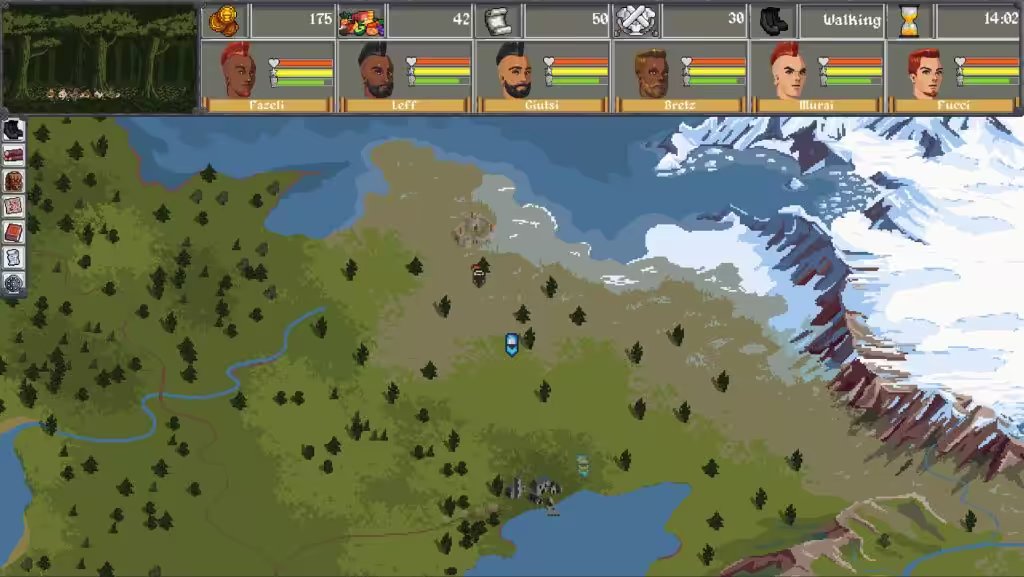
The overworld in The Adventurers is the space between contracts. You are on Shion. You start at Prycoast. You walk or you run, you spend supplies, you camp, and you hope the next hex is a town with a hammer and not a night fight you booked by sprinting. This page is movement and places. Job types sit in quests. Hex rules sit in combat.
This is not a complete atlas. Named sites below are either the official start town or early-route examples from playthroughs. If a wiki page ever listed a full country of invented cities, ignore it.
Prycoast and the first road
Prycoast is the starting town. Town Hall, tavern, blacksmith, enchanter, general goods, and barbershop are the buildings you will keep using. Leave on foot. The first hours of a campaign are a road, a camp, and a contract marker, not a fogged exploration minigame.
Strongfey Dell and a nearby goblin cave show up in early playthroughs as examples of that first loop — a place you can actually walk to while the company is still learning Energy. Treat them as a common opening neighborhood, not as the only forest on Shion and not as a guaranteed identical spawn in every origin.
The lost city of Ormill is a place people mention. It is not a world crisis. Do not confuse it with Crown Of Ash, Iron Crisis, Shattered Veil, Silent Concord, Gilded Eclipse, or Verdant Reckoning.
Walk, Run, supplies, night
Walk is how you keep supplies and daylight. Run burns supplies and is the reliable way to meet night fights. Night combat uses fog of war. If you have never fought in the dark, running a long leg after a late Town Hall click is a travel mistake with combat consequences.
Supplies are the overworld tank. Energy is the battle tank (Resolve for the pool, Vitality for recovery). Camp is how you convert one into the other: cook and hunt for the road, maintain gear for the next hex, guard because you stopped, socialize because personalities leak otherwise. Details of who enjoys those jobs are on party management.
Timers on contracts care about walking speed. A Search quest with Luck on the sheet still fails if you spend the clock in the wrong biome because you ran in circles. Buy stacks at general goods before a desert or snow crossing. Trade goods stack to 9; plan sells so the pantry is not nine pelts and no food.
Forts and biomes
Forts are waypoints with requests, training, soldiers, and a blacksmith. They are how a company lives off the main road. 1.0 made requests shorter and better paid (duration -50 percent, minimum two days, rewards +30 percent). Use a fort when a crisis or a string of patrols keeps you out of Prycoast. Do not treat every fort as an endgame raid; some are work yards.
Biomes change the hex you will fight on when something goes wrong.
- Forest often means mud.
- Desert and snow are difficult terrain.
- Unstable platforms (mud, sand, snow) apply 33 percent hit and damage reduction in combat.
- Flying creatures ignore difficult terrain.
High ground and choke points still matter. This page will not invent +10 percent accuracy for hills or +10 percent evasion for trees. If you need the one published terrain number, it is the 33 percent unstable-platform tax.
Fog of war is combat
Fog of war is not overworld exploration fog. You do not uncover Shion like a strategy-map shroud. You meet fog in combat at night and in caves. Outdoor combat vision is 250 percent extra view compared with cave interiors. Caves are where you bring light, pierce lines, and patience. Night is what you get when you Run because you hated walking.
Plan a day like a quartermaster. Start in Prycoast or a fort. Walk a timer you can beat. Camp before dark if the next marker is a cave. Keep one talker with Charisma in the party for speech events and shop prices when you hit a counter. Leave Ormill out of your crisis calendar.
When the demo is your map, you get eight days of this discipline and not the full fort-and-crisis layer — see the demo guide. When you want the honest 1.0 pitch for the whole sandbox, see the review.
Frequently Asked Questions
Quick answers about The Adventurers tactical RPG.
Where does the campaign start?
Prycoast, on the world of Shion. Town Hall, tavern, blacksmith, enchanter, general goods, and a barbershop are the starting-town buildings.
Should I Walk or Run?
Walk unless you can afford the supplies and a possible night fight. Run burns supplies. Night combat uses fog of war.
Is fog of war on the overworld map?
No. Fog of war is a combat rule for nights and caves. Outdoor combat view is 250 percent extra compared with caves.
What places can you actually name?
Prycoast is the start town. Strongfey Dell and a goblin cave appear as early-route examples in playthroughs, not as a full atlas. Ormill is a lost city, not a crisis.
How do biomes affect fights?
Forest mud, desert, and snow are difficult or unstable ground. Unstable platforms cut hit and damage by 33 percent. Flying enemies ignore difficult terrain.
Why stop at forts?
Forts offer requests, training, soldiers, and a blacksmith. 1.0 shortened request times and raised rewards, so they are worth using as road bases.